Reels are how Instagram shows your business to people who don’t follow you yet, and length is one of the first decisions you make when you plan one. It sets how much you can say, how fast the Reel has to move and how many people stay until the end, which is the signal Instagram uses to decide whether to keep showing it to new viewers.
The limits have also changed several times in the last two years. Instagram raised the maximum from 90 seconds to 3 minutes and then to 20 minutes, and Facebook dropped its limit altogether, so a lot of the advice you’ll find online still quotes numbers that no longer apply.
If you’d like to know how long your business’s Reels should be, this guide covers the current limits, what the data says about length and views, the length that suits each kind of Reel, and how to tell from your own Insights when a Reel runs too long. It’s part of our guide on how to make Reels for your business.
For a business, 30 to 90 seconds covers most ideas. In Socialinsider’s 2026 analysis of 6 million brand Reels, those between 45 and 60 seconds got the most views, and anything from 30 seconds to 3 minutes performed about the same. The right length for any one Reel is the shortest one that still gets its idea across.
How Long Can a Reel Be?
A Reel can be up to 20 minutes long on Instagram, has no length limit on Facebook, and can run up to 60 minutes on TikTok. The number that matters for a business is a different one, though: Instagram only recommends Reels of up to 3 minutes to people who don’t follow you.
| Platform | Longest Reel | What to know |
|---|---|---|
| 20 minutes | Only Reels up to 3 minutes are recommended to non-followers. The shortest is 3 seconds. | |
| No limit | Every new video has been published as a Reel since Meta’s 2025 update. | |
| TikTok | 60 minutes | 10 minutes if you film inside the app. |
Instagram accepts Reels from 3 seconds up to 20 minutes, but a Reel over 3 minutes is only shown to people who already follow you. It still appears on your profile and in your followers’ feeds, while the Reels tab and Explore, where new people find your business, only carry Reels of 3 minutes or less. For a business that wants Reels to bring in new customers, 3 minutes is the real limit, and the rest of this guide works inside it.
Meta announced in 2025 that every new video on Facebook would be published as a Reel, and removed the length limit that used to cap Facebook Reels at 90 seconds. Since anything that fits on Instagram now fits on Facebook as well, one file covers both, and you can share a Reel to your Facebook Page straight from Instagram when you post it.
TikTok accepts uploads of up to 60 minutes, or 10 minutes when you film in the app.
What Reel Length Gets the Most Views and Engagement?
Reels between 45 and 60 seconds get the most views and the highest engagement, but anything from 30 seconds to 3 minutes performs close to them. That data comes from Socialinsider’s analysis of 6 million Reels posted by brand accounts between January and June 2026, which is the largest recent dataset on business Reels / short form content we’ve found.
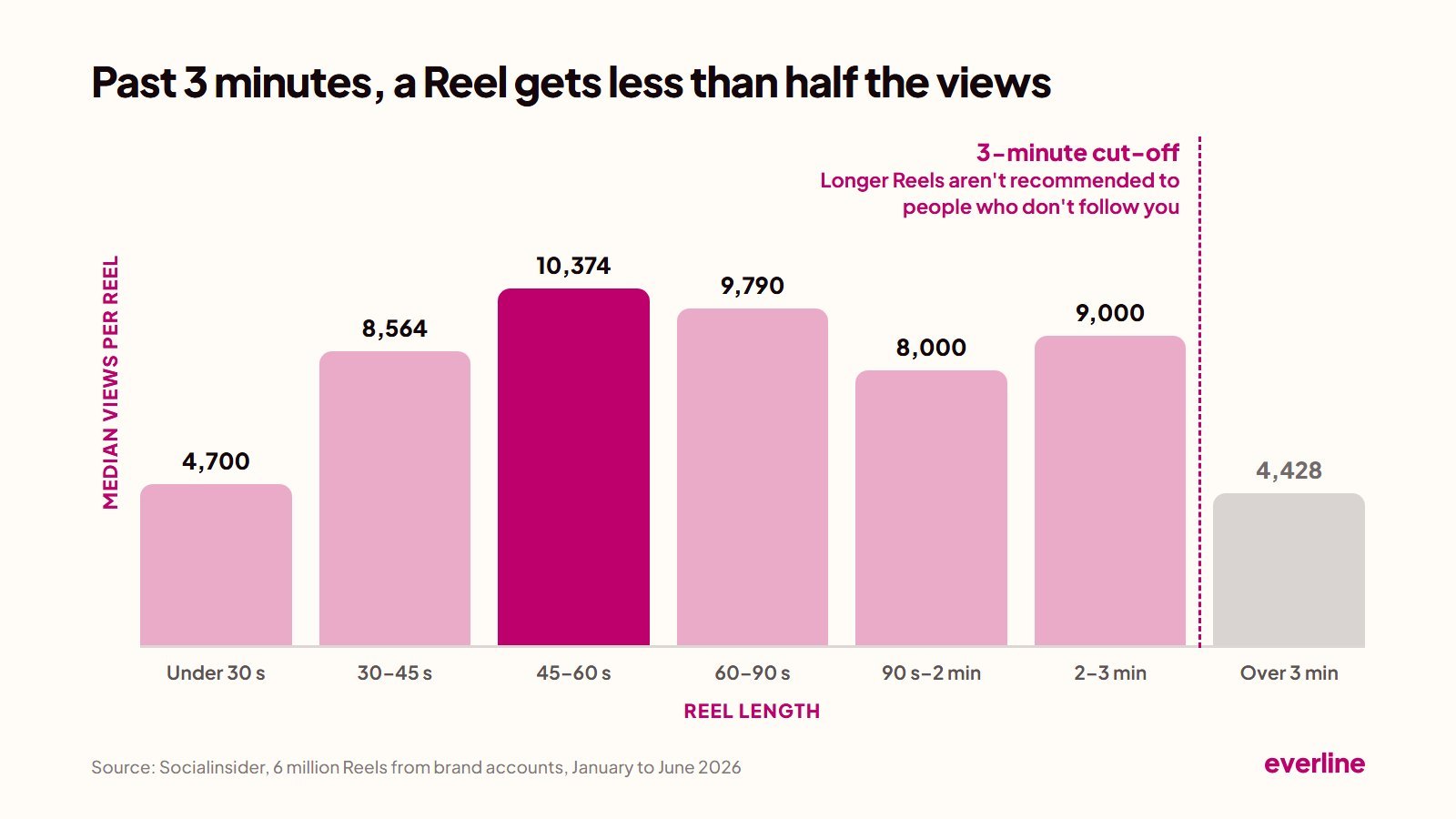
Reels of 45 to 60 seconds had a median of 10,374 views. Everything else between 30 seconds and 3 minutes landed between 8,000 and 9,800, while Reels under 30 seconds got 4,700 and Reels over 3 minutes got 4,428, less than half the peak. Engagement followed the same pattern, highest at 0.35% for 45 to 60 seconds and lowest at 0.15% past 3 minutes.
The drop past 3 minutes is the recommendation cut-off from the previous section showing up in the numbers. The drop under 30 seconds is harder to read. Very short Reels are often a single clip posted without much planning, so in our reading part of that gap comes from what gets posted at that length rather than from the length itself.
Inside the 30-second to 3-minute range, the differences are small enough that length matters less than whether people keep watching. A 90-second Reel that people watch to the end does better than a 45-second one they scroll past in the first 3 seconds, because Instagram decides who else sees a Reel from how long people watch it and how many of them skip it. The next two sections cover how to pick the length for each kind of Reel, and how to check whether yours are holding attention.
How Long Each Kind of Business Reel Should Be
The right length comes from what the Reel has to do: a single moment needs 7 to 15 seconds, a tip or a story needs 30 to 90, and an offer needs 10 to 20. These are the general ranges we work with when we plan Reels for clients (there are no hard rules). Two of them sit under the 30 seconds where the data showed fewer views, and that’s deliberate, because stretching a 10-second idea to 30 seconds gives people 20 seconds of nothing to scroll away from, which costs more reach than the extra length could bring.
A Single Moment or Product Shot: 7 to 15 Seconds
One satisfying shot, like a dish being plated or a finished haircut turning towards the camera, can carry the whole Reel. Keep it short enough that it loops before anyone thinks of scrolling, since a viewer who watches it twice adds to its watch time, and watch time is what tells Instagram to show it to more people.
Behind the Scenes or a Process: 20 to 45 Seconds
Showing how an order gets packed or how the kitchen gets ready before opening works because people like seeing how the work is done, and that takes a few steps rather than one shot. Use four to six moments, hold each one only as long as it takes to understand it, and end on the finished result.
A Tip or How-To: 30 to 90 Seconds
Teaching something takes the most time, because every step has to be shown or said clearly enough that someone could repeat it. Let the Reel run as long as the steps need, and cut everything that isn’t a step, starting with a long introduction of who you are.
A Story: 45 to 90 Seconds
A story is the owner explaining why they started, a regular customer, or a product being made from start to finish. It needs a setup and a payoff, and 45 seconds is about the least that leaves room for both. Go past 90 seconds only if the story holds attention all the way through, which the retention chart in the next section will show you.
An Offer, Event or Announcement: 10 to 20 Seconds
A new menu item, a weekend discount or an opening date is one piece of information and one call to action. Put both on screen early, show the product or the place, and stop there, because anything longer starts to feel like an ad and people scroll past it like one.
How to Tell if Your Reel Is Too Long
A Reel is too long when people leave before the end, and Instagram shows you where they leave. Open the Reel, tap View insights, and check two things.
Skip rate is the share of viewers who scrolled past in the first 3 seconds. If it’s high, the problem is the opening rather than the length, so start by fixing the hook.
The retention chart shows what share of viewers is still watching at each second. A gentle downward slope is normal, while a sharp drop marks the exact moment the Reel loses people, usually a slow intro, a point made twice or a shot held too long. Compare the average watch time with the Reel’s length too: 9 seconds watched on a 40-second Reel means most people never reached the payoff.
Cut the part where the line drops, move the payoff earlier, or split one long Reel into two. Cutting every pause, which we cover in how to edit Reels, takes off more seconds than most people expect.
When to Hand It Off
The right length is decided when a Reel is planned, so it’s easiest to get right when the same people plan, film and edit, which is something we at Everline Media do. We film and edit single Reels for €110 each, or ten for €850, and edit footage you’ve filmed yourself for €70 a video. Our social media and video packages cover the whole process, starting at €500 a month. We break down what goes into those prices in our guide to short-form video pricing.