Comparing website quotes can be confusing when the same five-page site is quoted at €500 by one agency and €5,000 by another. A large part of what separates those prices is work you don’t see on the page: loading speed, search engine visibility (whether you show up on Google), structured Google business data, alt text for screen readers, redirects, security updates, backups, and a cookie banner that follows privacy law. Two sites can look almost the same on launch day while one has all of that done and the other doesn’t, which is why the prices can end up so far apart. The site with all of that extra work done will attract many more visitors, they will stay for longer, and likely convert better.
Knowing what a small business website should cost helps you see which quote is fair, which is too high, and which is cheap because it skimps on work that really should be included. How much a website costs for a small business comes down to what each quote covers, and in this guide we will explore why the totals differ so much.
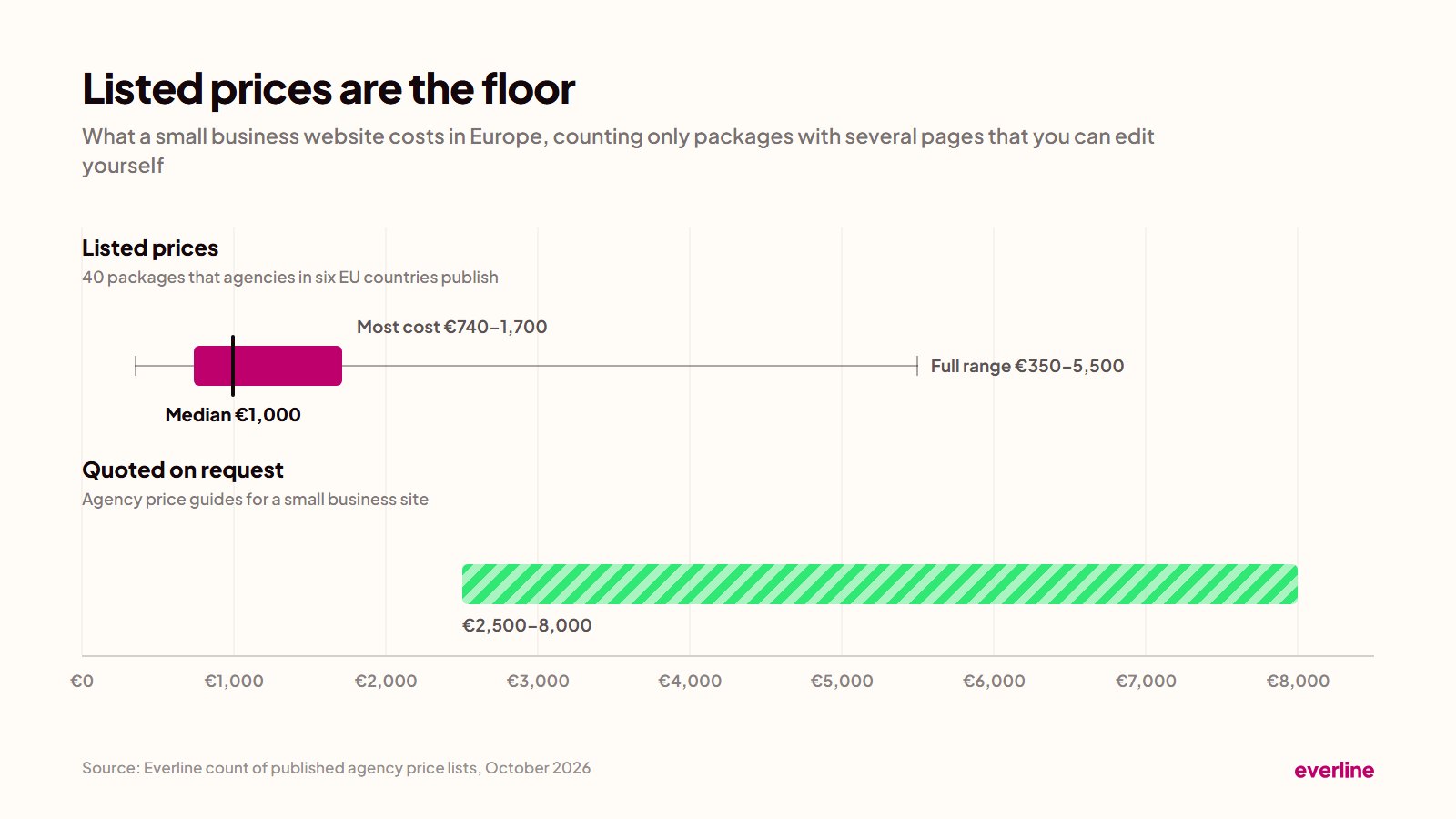
In Europe, a simple website with a few pages that you can edit yourself costs about €1,000 at the prices agencies publish, and most comparable packages fall between €740 and €1,700. Those are listed prices, and agencies that only quote on request usually charge more, so the true median is higher.
This guide covers how much a website costs for a small business in Europe, based on 40 published packages from agencies in six EU countries, what makes one site cost ten times as much as another, the small technical work that cheap quotes tend to skip, how much a website costs per month and per year once it’s live, and how to compare quotes before you sign.
How Much Does a Small Business Website Cost in Europe?
A small business website costs about €1,000 in Europe when you buy it from an agency’s published price list, with the middle half of comparable packages between €740 and €1,700 and the full range running from €350 to €5,500. We got these numbers from web agencies and freelancers in Germany, France, the Netherlands, Italy, Spain and Croatia in October 2026 and took each one’s cheapest package that has several pages and lets you edit the site yourself, which gave us 40 packages to compare. One-page sites and sites you can’t edit were left out, because they’re a different product, and putting a one-page site next to an editable five-page one wouldn’t be comparable.
Where the agency is based changes the price due to differences in living standards and wages. The German packages in our count sit around €1,700, the Croatian ones around €490, and those from France, the Netherlands, Italy and Spain mostly fall between about €900 and €1,600.
These are listed prices, which makes them the floor rather than the average. Agencies that publish their prices tend to be the cheaper ones, while many established agencies only quote on request, and their numbers sit higher: one Italian agency’s budget form starts at €3,500, and agency price guides in Germany, France and the Netherlands put a small business site at roughly €2,500 to €8,000. So when you’re working out how much a website should cost for a small business, the listed prices tell you where the market starts, and what you end up paying depends on the “additionals” that your business needs, which the next two sections cover.
Cheaper options do exist if you need less. A single landing page starts at about €250 at the budget end of the market, and some agencies sell sites without an editing system from a few hundred euros, which can be enough for a business that rarely changes its website but means paying someone every time a price or opening hour changes.
Why Does One Website Cost €500 and Another €5,000?
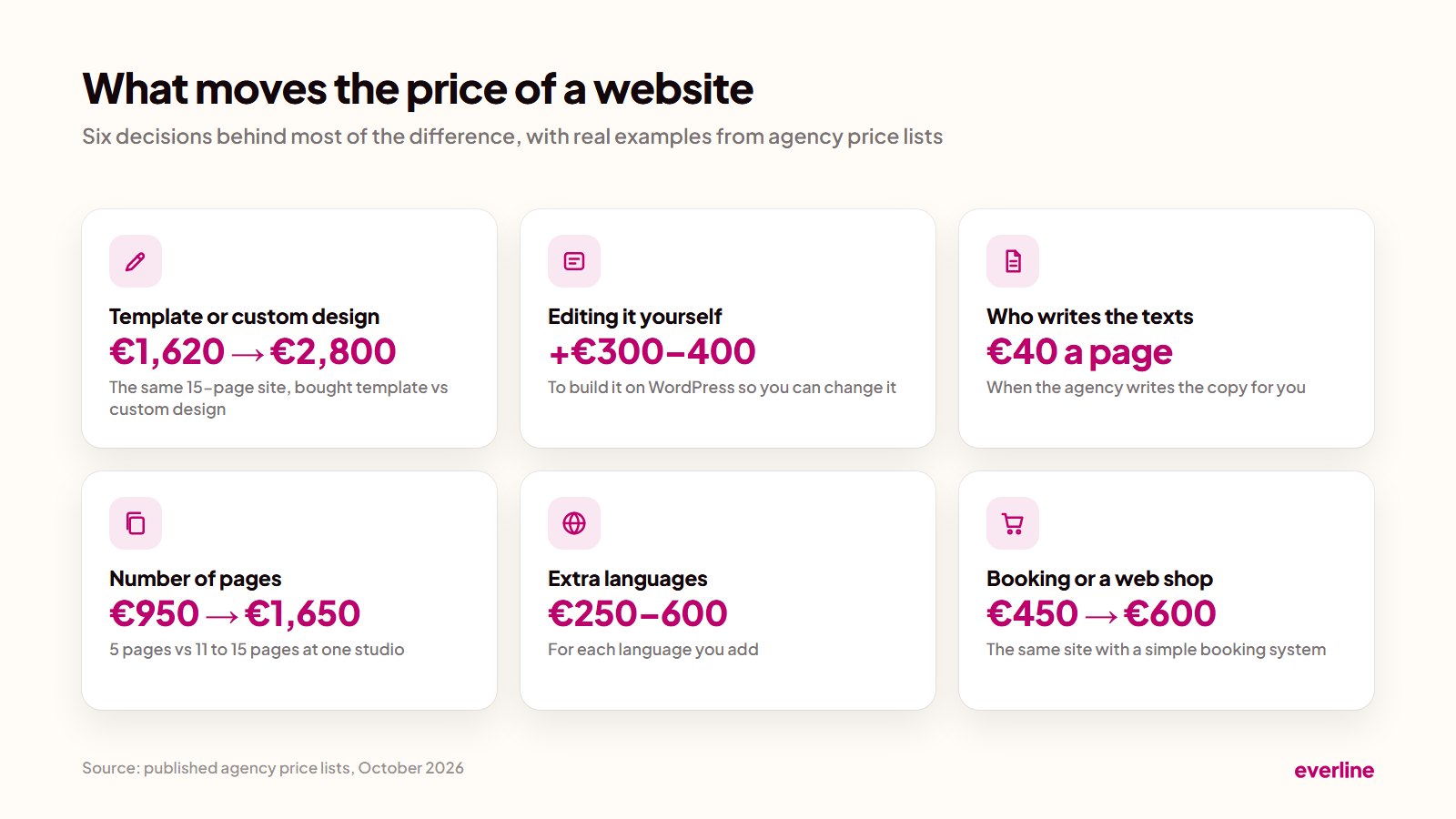
How much a simple website costs comes down to a handful of decisions that each add hours to the job, and two quotes for “a five-page website” can be thousands of euros apart because of this. These are the six that move the price most:
Template or Custom Design
A template site and a custom-designed one can have exactly the same pages and still be priced far apart. One Italian agency sells the same 15-page site for €1,620 on a bought template and for €2,800 with a custom design, and the difference pays for the design time. A template can work, but often limits your business because it’s not custom made for it.
Whether You Can Edit It Yourself
A site built on WordPress or a similar editing system takes more setup than a static one, and some agencies price that separately. One German studio sells a three-page site for €599 and charges €300 more to build it on WordPress, and a studio in Spain adds €400 for the same thing. Without an editing system, every change to a price, a photo or your opening hours goes back to the agency and gets billed, usually by the hour, at €30 to €110 an hour in the price lists we read.
Who Writes the Texts
Text (copy) is the part of a website most quotes leave to you. Some packages include copywriting, while others charge for it per page, at €40 a page at one Croatian agency, and if you write the texts yourself, the site waits until you’ve finished them.
Number of Pages
Pages are the most visible price driver, and some agencies price them on a straight ladder. One German studio charges from €950 for five pages, €1,200 for six to ten and €1,650 for eleven to fifteen, and agencies that price per page add €40 to €70 for each page beyond the package.
Languages
Each extra language means translating and setting up every page again, and the price lists we read charge €250 to €600 per language. One Croatian agency charges €250 for one extra language, €400 for two and €550 for three, so a site in three languages costs noticeably more than the same site in one.
Booking or a Web Shop
Booking and selling online turn your website into an entirely different product, and are more expensive as a result. One Croatian agency charges €450 for a multi-page site and €600 for the same site with a simple booking system, and simple web shops start higher again, from around €900 in Croatia and €2,500 to €3,000 in Western Europe in the price lists we read, before you count payment fees and the time it takes to add your products. If you rent out apartments or cabins, we go through what a booking website needs and what it saves you in commission in our guide to getting direct bookings.
The Small Technical Work That Makes a Website Rank and Work on Phones
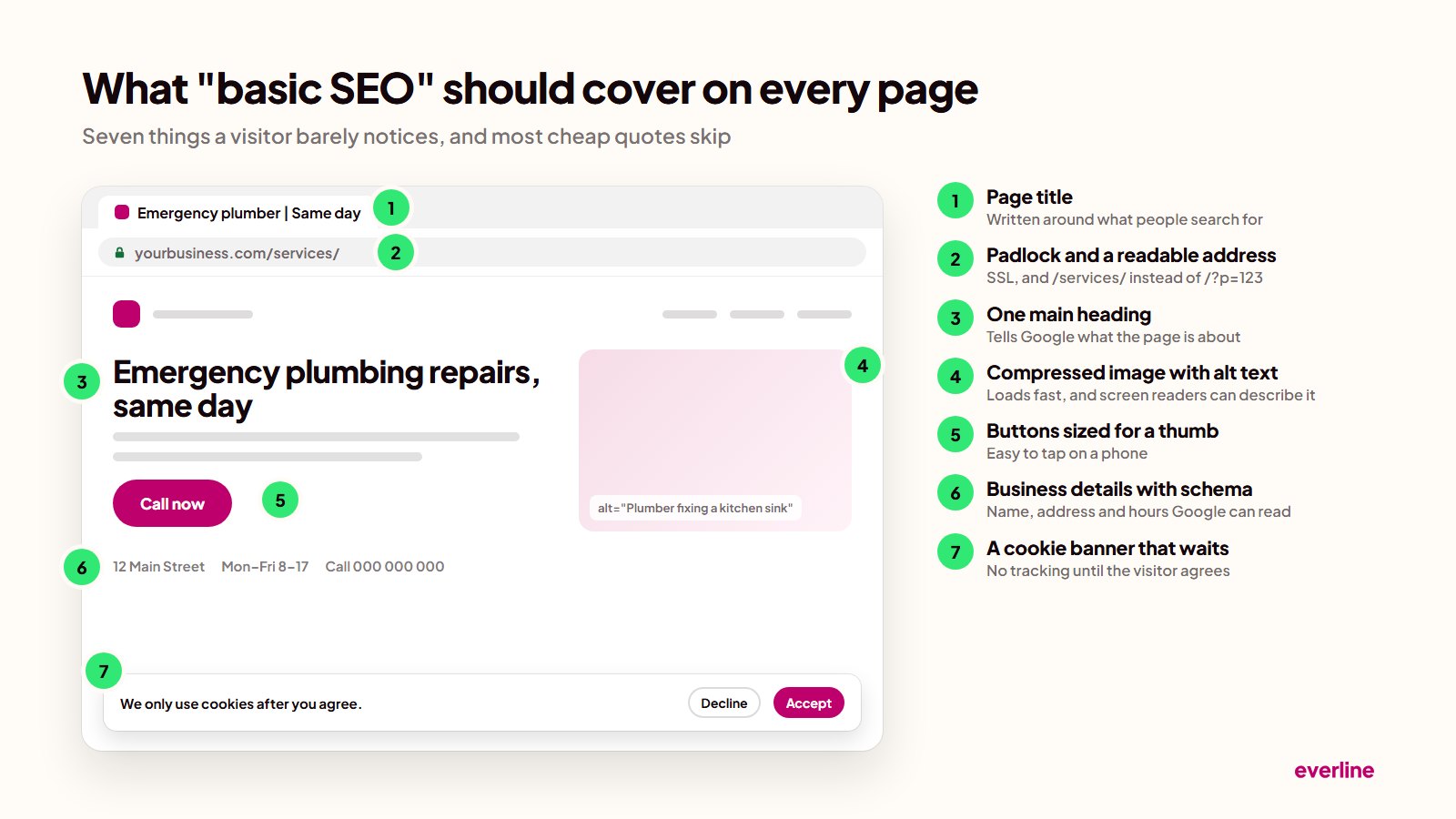
This is a huge part of the difference between a €500 site and a €1,500 one. Each item below adds between a few minutes and a few hours of additional work, but it isn’t visible on the website directly, and that makes it the first thing a budget agency squeezes out, usually by writing “basic SEO” in the quote without saying what that covers.
Getting Found on Google
- A unique title and description for every page, written to show up as an answer to what people search for (finding out what people search for is a task in itself, which agencies often pay software for).
- One main heading per page and a clear heading structure, so Google can tell what each page is about.
- Readable page addresses, such as “/services/” rather than “/?p=123”.
- A sitemap submitted in Google Search Console, so new pages get found and indexed.
- Local business schema, the structured data that gives Google your name, address, opening hours and service area.
- Your Google Business Profile linked to the site, which matters for local searches.
- Links between your own pages, so visitors and Google can move from a service to the contact page, and so on.
- Redirects from the old site’s pages when a site is replaced, because without them the pages Google already ranks start returning errors and the rankings they built up can be lost.
Working on a Phone
- A layout tested at phone and tablet widths (and not just the desktop page squeezed smaller).
- Buttons and links big enough to tap without hitting the wrong one.
- Images compressed and sized for the screen, in modern formats like WebP, which is most of what makes a small site load fast.
- Good Core Web Vitals scores, Google’s measures of how quickly a page loads and responds, which feed into its rankings.
- No bugs or jitters while the page loads, which is one of those measures and the reason people tap the wrong thing.
Getting Found by AI Assistants
- Pages that answer the questions customers ask in simple terms, such as what a service costs and how long it takes, which the AI tools quote.
- Structured data, the same schema that helps Google, which makes your business details easy for AI tools to read.
- Not blocking AI crawlers by accident in the site’s robots.txt file, which some hosting and security settings do by default.
- Consistent name, address and contact information everywhere online, so Google and AI tools can match your site to your listings.
- An llms.txt file, a short summary of the site written for AI tools.
Being Accessible to Everyone, and Legal
- Alt text on images, which screen readers read aloud and Google uses to understand the image.
- Enough contrast between text and background to read on a phone in daylight.
- Labels on every form field, and a site you can move through with a keyboard.
- SSL certificate, the padlock in the address bar, without which browsers warn visitors that the site isn’t secure.
- A cookie banner that blocks tracking until the visitor agrees, which GDPR requires and plenty of banners on small sites don’t do.
- A privacy policy that matches what the site collects.
- A favicon and a share image, so the site looks finished in a browser tab and when someone posts the link.
EU accessibility rules have applied since June 2025, but they list specific services, such as online shops, ticketing and banking, rather than websites in general, and service businesses with fewer than 10 employees and under €2 million in turnover are exempt. The basics above are still worth doing, because they widen who can use the site and overlap with what Google already rewards.
When a quote says “basic SEO”, ask which of these it covers.
What Cheap Website Quotes Leave Out
A low quote often covers the build and nothing around it, meaning a cheap website will cost you more money later. These are the items to check before you compare totals:
- Hosting and the domain after the first year. Many packages include both for twelve months and then bill them separately. Hosting for a small site costs roughly €35 to €70 a year at the agencies we read, and a .com domain about €12 to €15.
- Maintenance after launch. WordPress, its theme and its plugins need regular updates to stay secure, and that work is either in a plan or billed by the hour when something breaks. The next section covers what it costs.
- Photos. Some packages include a set number of stock photos or edit the ones you send, while others expect you to supply every image ready to use.
- “From” prices. A package priced “from €X” is the starting point for the smallest version of it, and the final price is set once the agency knows your pages, texts and features.
Ownership is the part people check least. The domain should be registered in your name, so you keep it if you ever change agency, and once the site is paid for you should get the admin login and, ideally, access to the hosting account too. A site that only the agency can log into is one you’re renting, whatever the invoice says.
How Much Does a Website Cost per Month?
A website costs roughly €30 to €40 a month to run once it’s live, for hosting, the domain and a basic maintenance plan, which works out to about €350 to €500 a year. Hosting and a .com domain together come to about €50 to €85 a year for a small site, and the cheapest maintenance plan each agency publishes has a median of about €30 a month across the 28 plans we found, with most between €20 and €55 and the full range running from €5 to just under €100.
What a maintenance plan covers varies as much as the price. The cheapest ones update WordPress and its plugins and keep a backup, while the more expensive ones add security monitoring, small content changes each month and someone to call if issues arise, so compare what’s in the plan before you compare the price.
Subscription or a One-Off Build
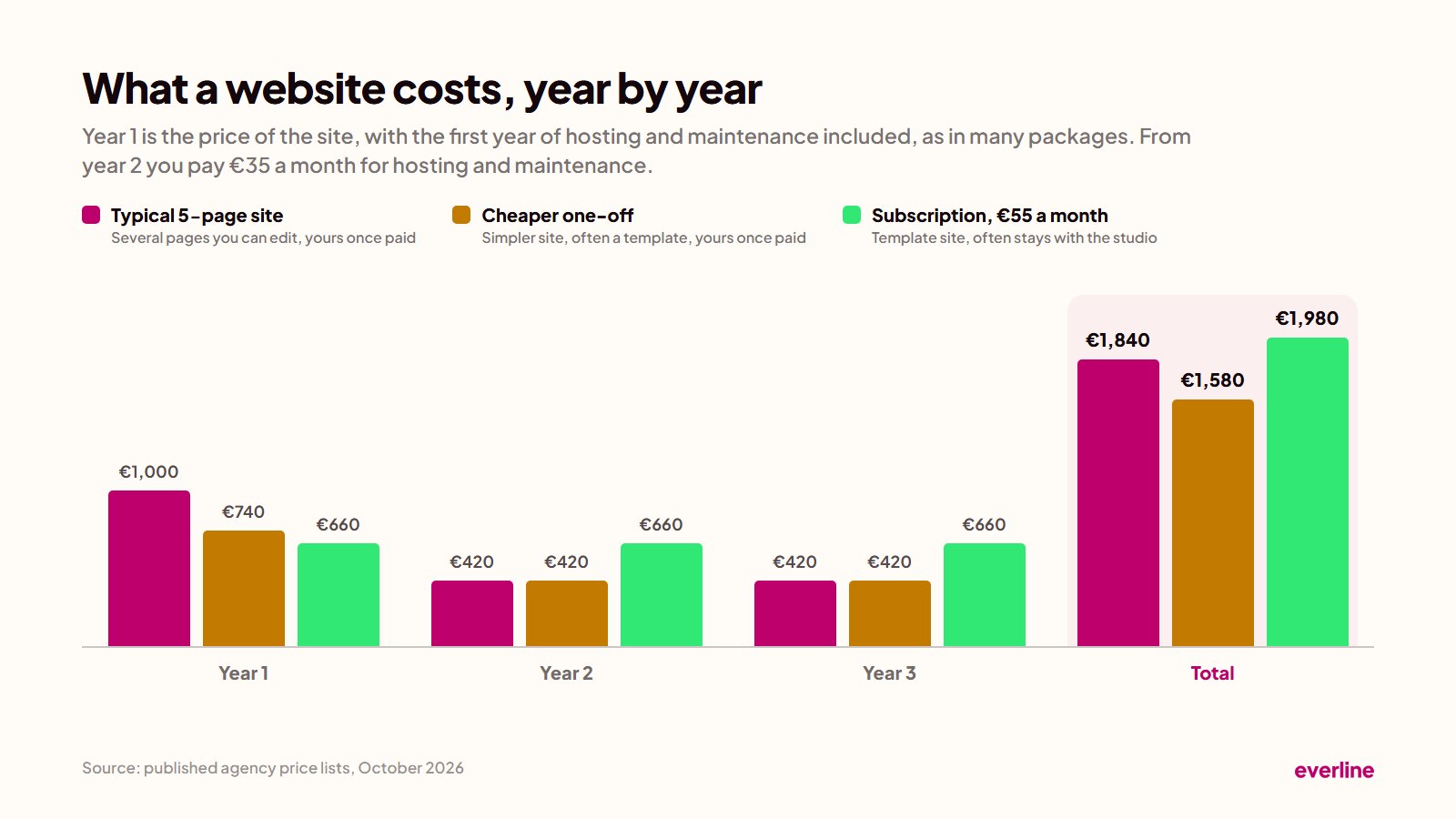
Some studios build the site for no upfront fee and charge a monthly price instead, which bundles the build, hosting and maintenance into one payment. The subscriptions we found cost a median of about €55 a month, with most between €45 and €75, and many come with a minimum term of twelve or twenty-four months.
Subscription sites tend to be the simpler, template-based end of the market, so the fair comparison is a one-off build at the cheaper end too. Over three years, a one-off build at about €740 plus €35 a month for hosting and maintenance after the first year, which many packages include, comes to roughly €1,600, while a €55 subscription comes to about €2,000, around a quarter more. A typical five-page site at the €1,000 median comes to about €1,850 over the same three years, still less than the subscription, and it’s yours once it’s paid.
The other difference is what you own when you stop paying. With a one-off build the site is yours once it’s paid, while with a subscription it often stays with the studio, so ending the contract can mean losing the site, unless the terms let you buy it out, as one studio we read allows after twelve months. A subscription suits a business that wants no upfront cost and no maintenance to think about, and a one-off build suits one that wants to own its site and choose who looks after it.
How to Compare Website Quotes
Put your quotes side by side and ask each agency the same questions, because the answers explain most of the difference in price.
- How many pages are included, and what does an extra page cost? Two quotes might cover very different page counts.
- Is the design custom or built on a template? Both can work, but they shouldn’t be priced as if they were the same thing, and custom is always better.
- Who writes the texts? If it’s you, count the time, and if it’s the agency, check it’s in the price.
- Can you edit the site yourself, and will someone show you how? Without that, every small change becomes a paid request.
- What exactly does “basic SEO” include? Ask for the list: titles and descriptions, headings, sitemap, schema, speed and redirects.
- Has the site been tested on phones, and does it meet accessibility basics? Many of your visitors will see it on a phone first.
- Are hosting and the domain included, for how long, and in whose name? This decides your cost from the second year and whether you keep your address if you leave.
- What does maintenance cost after launch, and what does it cover? A site nobody updates gets slower and less secure over time.
- Who owns the site once it’s paid? You want the domain in your name, the admin login and the full site handed over.
What a Website Costs With Everline
Our Starter website costs €1,000 and covers up to five pages, designed from scratch for your business and live seven days after you sign. Every package includes the technical work from the section above: a custom mobile-first design, help writing the texts, page titles and descriptions, a clean heading structure, local business schema, alt text, accessibility basics, an llms.txt file, speed work, Google Analytics and Search Console, SSL, a cookie banner and privacy policy, your Google Business Profile linked, and redirects if we’re replacing an old site. The first six months of hosting, the domain and maintenance are included, you get a training call so you can edit the site yourself, and the site is yours once it’s paid.
The Business package costs €2,000 and adds up to twelve pages in two languages, a blog, and either a booking tool or a web shop with up to 30 products and card payments, and it’s live in ten days. Custom projects, such as large web shops with supplier imports or booking systems with online payment, start at €3,000. You pay 30% when you sign and 70% at launch, and from the seventh month, hosting, the domain and maintenance together cost €40 a month. Our website cost calculator prices your exact setup, with any extra pages, languages or features.
For an example of what we build beyond the packages, for one of our clients, Tuner Shop, we built a custom car parts web shop where customers can search 56,000 parts by their exact vehicle model, and you can see all three packages side by side on our websites page.