If you own a hotel or short-term rental apartments, you know that every guest who books your apartment or cabin through Booking.com or Airbnb costs you a share of the booking, usually around 15% to 18%. We’re here to tell you that many of those guests would book with you directly if they had the option, such as people who stayed last year and want to come back, or people who found you on Airbnb and then searched your name on Google to see more photos. A direct booking website would give them that option, and every booking that comes through it is one you keep in full, apart from a small card fee. So how does one get direct bookings on their property?
How to get direct bookings comes down to two things: a website where guests can book without leaving it, and a way for guests to find it. The website needs an availability calendar that syncs with Airbnb and Booking.com so you’re never booked twice, a way to book (an enquiry form or instant booking), a deposit or card payment, photos and prices for each season, and the languages your guests speak. Guests find it when they come back for a second stay, when they search your property’s name after seeing it on Airbnb, and through your Instagram profile.
And the best part is that you don’t need to leave Airbnb or Booking.com to do this, because they’re still one of the best ways to reach guests who have never heard of you. This guide covers what those platforms take from each booking, what a direct booking website for a short-term rental needs, whether to use a booking plugin on your own site or a platform’s website builder, how to get guests to book direct, and what it all costs.
How Much Do Airbnb and Booking.com Take From Each Booking?
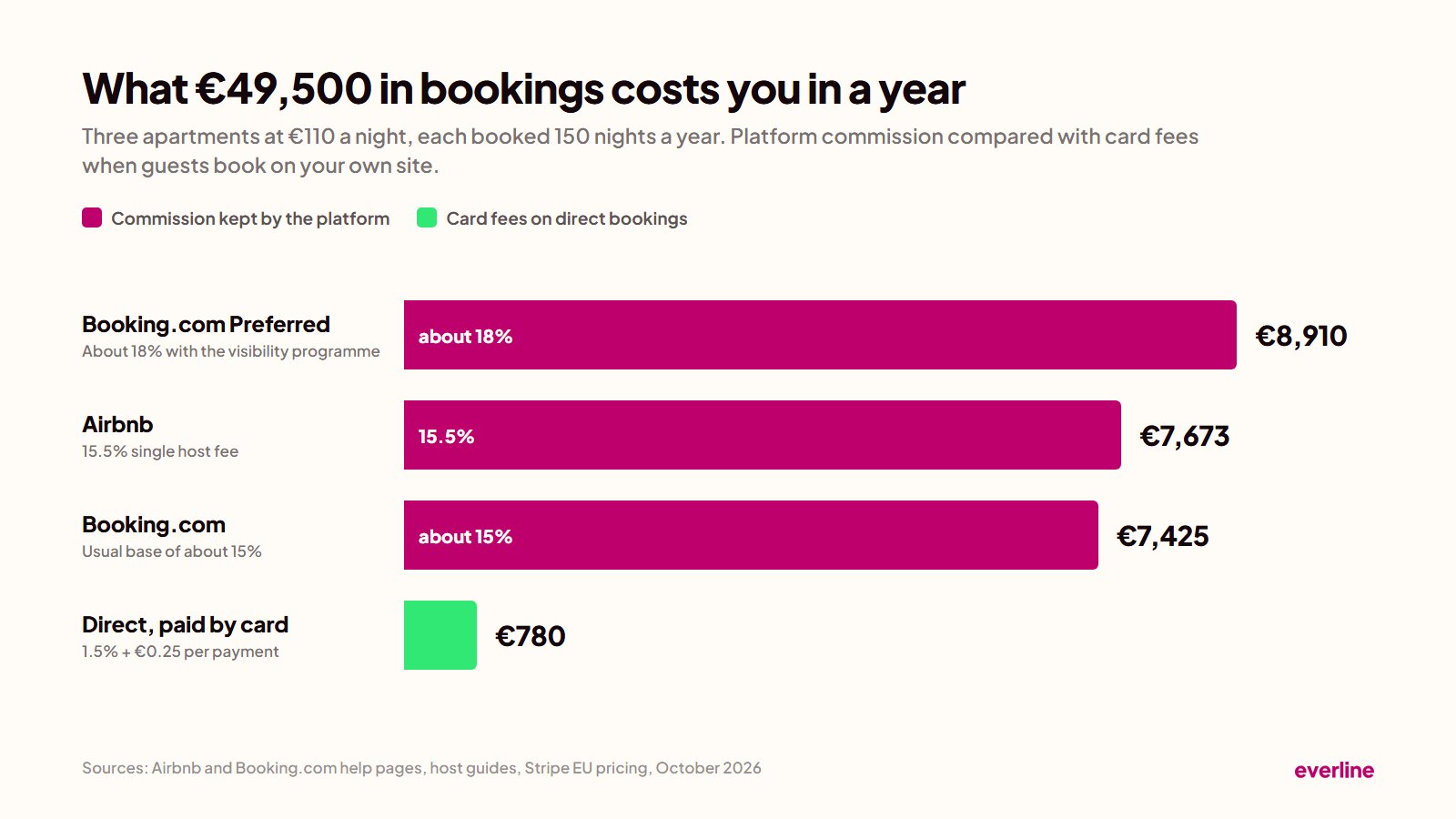
Airbnb takes 15.5% of each booking from most hosts, and Booking.com usually takes around 15% to 18%, although its rate depends on your country, the type of property and the agreement you signed when you joined. Both charge their share on the full booking amount, which means the cleaning fee and any other extras you add are included, not only the nightly price.
Airbnb Host Fees
Airbnb is moving every host to a single service fee that is deducted from your payout before you receive it. Most hosts pay 15.5%, and the rest typically pay between 14% and 16%. Under the old split fee, hosts paid 3% and guests paid 14% to 16% on top of the price, but Airbnb is phasing that model out. Hotels, serviced apartments and hosts who use property management software already have to use the single fee, and once you switch you can’t go back.
Booking.com Commission for Hosts
Booking.com doesn’t publish a single commission rate. Its partner help pages say the percentage depends on your country, property type and contract, and guides for hosts put the usual base at around 15%. Joining a visibility programme raises it: Preferred Partner adds about three percentage points, which takes the total to around 18%. Booking.com also charges commission on cleaning fees, on any cancellation or no-show fees you collect and, in most countries, on VAT. If you let Booking.com handle guest payments, a processing fee of roughly 1% to 3% comes on top of that.
What the Commission Adds Up to Over a Year
Take three apartments that average €110 a night and are each booked for 150 nights a year, which is about 40% occupancy. That’s €49,500 in bookings, and at 15% the platforms keep about €7,400 of it, or close to €8,900 if you’re a Preferred Partner on Booking.com. The same €49,500 paid to you directly by card would cost about €780 in card fees at the standard rate for European cards, which is 1.5% plus €0.25 per payment (assuming guests stay three nights on average). You won’t move every booking to your own site, and you shouldn’t try, but every €100 booking that comes direct leaves you about €13 more than the same booking through a platform.
What Does a Direct Booking Website Need?
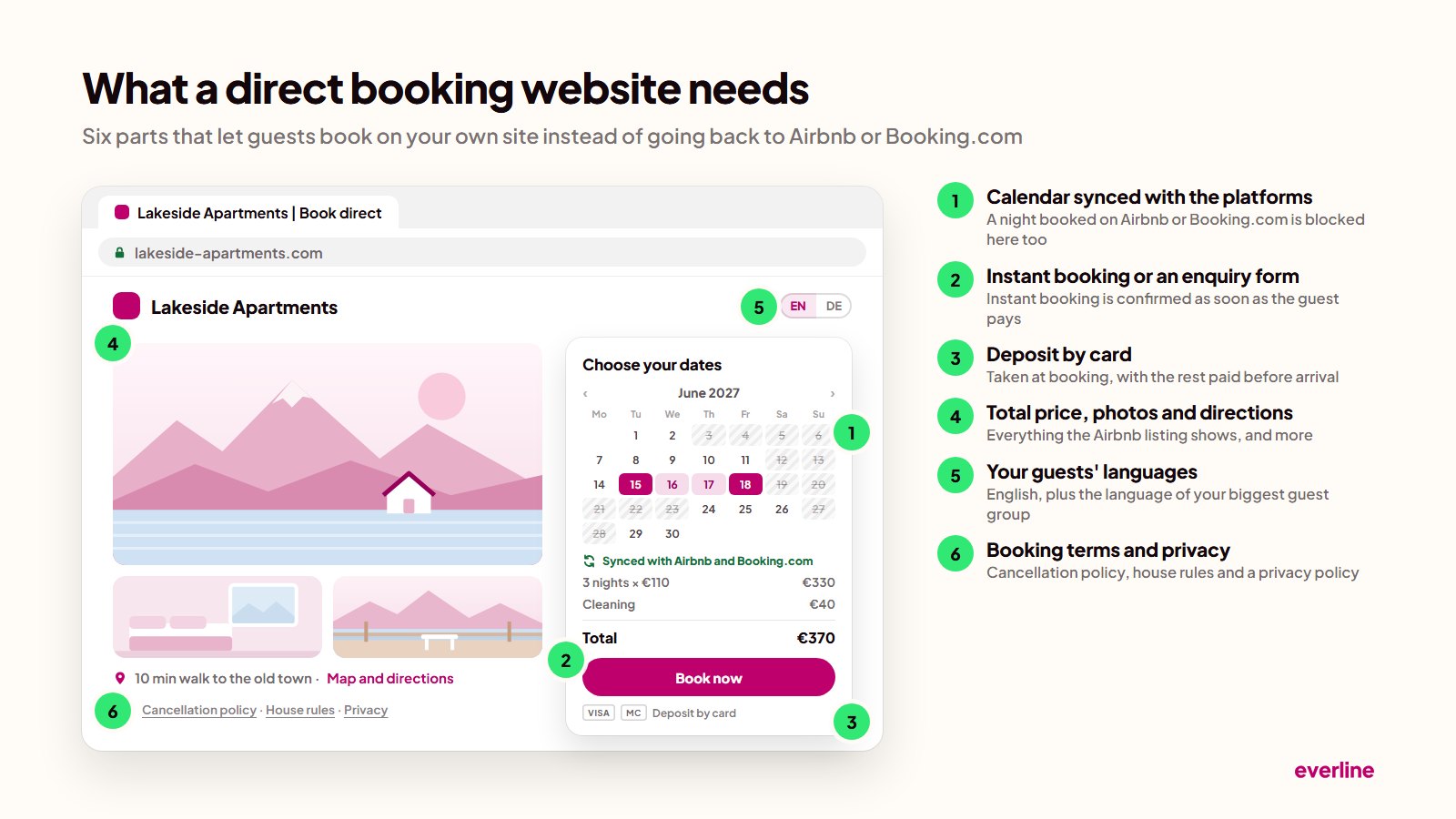
A direct booking website needs six things to take bookings on its own: a calendar that stays in sync with Airbnb and Booking.com, a way for guests to book, a deposit or card payment, clear prices with photos and directions, the languages your guests speak, and written booking terms. A site that only has photos and a phone number still sends guests back to the platforms, because booking there is easier.
A Calendar That Syncs With Airbnb and Booking.com
One of your first worries right now might be double bookings, but fear not, calendar sync is what prevents them. Airbnb and Booking.com both let you export your calendar and import calendars from other sites, so a night booked on your website is blocked on the platforms and the other way round. The sync isn’t instant, though. Airbnb refreshes imported calendars every three hours, which leaves a short window in which the same night can be booked twice. With a few apartments that rarely happens, but if you’re busy or run more units, a channel manager closes the gap by connecting to each platform directly instead of waiting for a refresh, and it can manage your prices across all of them as well.
Enquiry Form or Instant Booking
An enquiry form lets the guest send their dates, and you reply with a price and a payment link. It’s simple and cheap to set up, and it works well when you have one or two apartments and answer quickly, but each booking takes a few messages and some guests won’t wait for a reply. Instant booking shows live availability and the total price, and the booking is confirmed as soon as the guest pays, which is what guests are used to from Airbnb and Booking.com. It needs calendar sync and online payment to work properly.
A Deposit or Card Payment
Taking money at the moment of booking is what makes a direct booking hold. Most owners take a deposit when the guest books and the rest before arrival. A payment provider such as Stripe or PayPal handles the card, so you never see the card details, and pays the money out to your bank account. Decide on the deposit and the refund rules before your first booking, because they’re the first thing a guest asks about when their plans change.
Prices, Photos and Directions
Guests compare your site with your Airbnb listing, so show them the same things: the price for their dates including the cleaning fee, the minimum stay, photos of every room, what’s included, a map, and how to get there from the airport or station, but, and this is important, show them MORE. Show them more photos, videos, and anything that you couldn’t show on Booking.com or Airbnb. The site also has to load quickly and work well on a phone, since that’s where a lot of guests do their booking.
The Languages Your Guests Speak
Holiday rental guests often come from abroad, so a site only in your own language is one many of them can’t use. English is the minimum, and adding the language of your biggest guest group, such as German, helps you convert more visitors into guests because they are more likely to feel welcomed onto the site.
Booking Terms and a Privacy Policy
Airbnb and Booking.com set the cancellation and payment rules for you, but on your own site you write them yourself. That means you can write a custom cancellation policy, house rules, check-in and check-out times, and what happens to the deposit if the guest cancels. You’re also collecting guests’ names, email addresses and payments, so the site needs a privacy policy and a cookie banner that follows EU privacy law (if you’re in the EU).
Your Own Website With a Booking Plugin, or a Holiday Rental Website Builder?
There are three ways to set up a direct booking website for a short-term rental: have a website made for your property with a booking plugin added to it, build one yourself with the website builder that comes with holiday rental software, or have a website made and connect it to a channel manager. The first costs more up front and nothing per booking, the second is cheap to start but you pay for it every month for as long as you use it, and the third suits owners with enough units that the calendar can’t wait for a three-hour refresh.
Option 1: A Website Made for You, With a Booking Plugin
The first option is to hire a web designer or an agency to make a website for your property. You pay them once for the build, and they set the site up on WordPress or a similar system with a booking plugin, which adds the calendar, prices, booking form and card payment to your pages. The plugin has a free version, and the paid version, which adds calendar sync with Airbnb and Booking.com, costs a licence fee rather than a share of each booking. The site and the domain belong to you, the design is made for your property, and you can add pages about what guests look up before they book, such as the ski area or the beach nearby, which helps the site show up on Google. After launch, you pay for hosting and maintenance, which we cover in what a website costs per month.
Option 2: A Website Builder in Holiday Rental Software
The second option is to build the site yourself inside holiday rental software. Many of the programs owners use to manage their bookings and calendars include a website builder: you pick a template, add your photos and prices, and the booking engine and channel manager are already connected. It’s quick to set up, and prices start at about €15 to €30 a month for one unit, with each extra unit adding to the bill, so three apartments come to about €47 a month on one popular plan. Some plans take a share of each booking instead, between about 1% and 3%. The trade-off is that the site lives on the software company’s system. You’re limited to their templates, and if you stop paying or move to other software the site goes with it, although you keep the domain if it’s registered in your name.
Option 3: A Website Made for You, Connected to a Channel Manager
The third option is a website made for you, as in the first option, connected to a channel manager. A channel manager is software that updates your availability and prices on Airbnb, Booking.com and your own site at the same time, instead of every few hours. It suits owners with many units or a small hotel. The site stays yours, and the channel manager adds a monthly fee, usually charged per unit or per connected platform. It’s the most work to set up, and it pays off once double bookings, or changing prices by hand on three platforms, are already costing you time.
In monthly cost alone, a website builder is often the cheaper way to start, because it bundles software you would otherwise pay for separately. A website made for you is worth it when you want guests to find you on Google rather than only on the platforms, when you want the design and content to belong to you, and when you don’t want your bookings tied to one software company.
How to Get Direct Bookings Without Breaking Airbnb’s or Booking.com’s Rules
Direct bookings come from guests who find you outside the platforms: people who search for your property by name, guests who booked with you directly before, Google’s holiday rental listings, and your Instagram. What you can’t do is use Airbnb or Booking.com to move guests over to your site, because both platforms forbid it.
A Property Name Guests Can Search For
Guests who like a listing often look it up on Google to see more photos or to check the place is real. If your property has a name of its own, used the same way on your sign, your listings and your Instagram, the search leads them to your website. A listing called “Cosy two-bedroom apartment near the centre” gives them nothing to search for.
Google Vacation Rentals and Free Booking Links
Google shows holiday rentals in its search results and on Maps with links that send guests to book on your own website, and it charges nothing for those bookings. You can’t add a rental yourself. You connect through one of Google’s vacation rental partners, usually the rental software or channel manager you already use, so check whether yours offers it. A single holiday home can’t have a Google Business Profile, because Google’s guidelines exclude rental properties, but a hotel, a guesthouse or a rental company with an office can, and that profile links straight to your site.
Guests Who Booked Direct Before
A guest who booked on your own website is your guest, not the platform’s, so you can email them about next season, as long as they agreed to it when they booked. A checkbox on the booking form takes care of that. Every one of those guests who comes back is a booking with no commission at all, and returning guests are the most reliable source of direct bookings you’ll have.
Instagram and Local Partners
Guests check Instagram to see what a place and its surroundings look like, so keep your website link in the profile and post the views, the rooms and the area in season. Ski schools, tour guides, restaurants and the local tourist office can also link to your site, and a link from a local business brings guests who are already planning a trip to your area.
A Better Price or Perk on Your Own Site
For properties in the EU and the rest of the European Economic Area, Booking.com can no longer require that your own website isn’t cheaper. It dropped those parity rules in 2024 under the EU’s Digital Markets Act, and it says the prices you set elsewhere don’t affect your ranking on Booking.com. You can offer a lower price, a free late check-out or no cleaning fee for booking direct, and with commission at around 15%, a price 5% or 10% lower still leaves you more than the platform booking would. Just don’t advertise it to guests through Airbnb.
Should You Stay on Airbnb and Booking.com?
For most owners, yes. Airbnb and Booking.com bring guests who have never heard of you and would never find your website on their own, and for a new property or one without regular guests, that’s where most bookings come from. They also handle things you take on yourself with a direct booking: the guest pays the platform, Airbnb’s AirCover covers some damage, and disputes go through their support instead of your inbox.
The real difference between a direct booking and an Airbnb booking is who the guest belongs to. On Airbnb, the guest is the platform’s customer, and you pay 15.5% for that. On your own site, the guest is yours, you keep almost the whole booking, and you can invite them back next year. What works is keeping your listings for new guests and letting the website take the guests who search for you by name, come back for a second stay or find you on Google. Keep track of how many bookings come direct each season, because as that share grows, the commission you pay shrinks with it.
How Much Does a Direct Booking Website Cost?
A direct booking website costs €2,000 with Everline on our Business package: up to 12 pages in two languages, with a booking tool connected to your Airbnb and Booking.com calendars and card payment for deposits, live 10 days after you sign. A connection to a channel manager is a Custom project, from €3,000, and a third language adds €10 a page. Both include the design, help with the copy, basic SEO, the privacy policy and cookie banner, and two rounds of revisions, and the site is yours once it’s paid. Six months of hosting, the domain and maintenance are included, and after that all three cost €40 a month. You pay 30% when you sign and the remaining 70% at launch. Our website cost calculator prices the extras on top, such as gift cards, a third language or more pages.
If you want to compare with other agencies, we went through published prices across Europe in what a website costs a small business, and everything each package includes is on our websites page.